New Delhi
August 13, 2026
Cybersecurity is no longer only about protecting machines, networks and data but it is increasingly about understanding the human being behind the system. Addressing this emerging frontier, C-DAC Delhi is pioneering research at the intersection of Artificial Intelligence, Neuroscience, Behavioural Analytics and Cybersecurity, exploring how human cognitive and behavioural signals can provide a new dimension to Human Threat Intelligence (HTI).
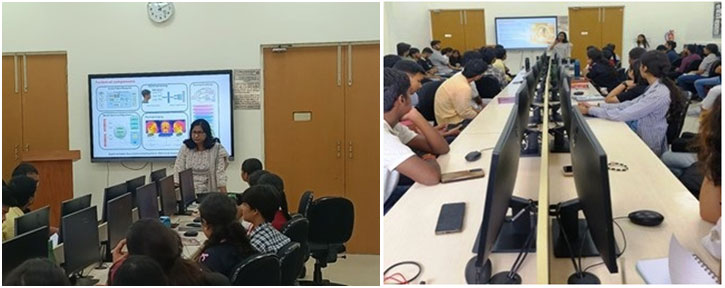
As part of this effort to take cutting-edge research from the laboratory to the wider academic and innovation ecosystem, C-DAC Delhi conducted a one-day workshop on “Applications of Artificial Intelligence for Next-Generation Cybersecurity” on August 13th, 2026, organized by Ram Lal Anand College, University of Delhi. The event took place under the MeitY funded Project “Cyber-Forensic Framework for User-Centric Human Threat Intelligence Analysis”. The workshop was delivered by Dr. Geetanjali Srivastava, Neuro Research Scientist Ms. Arpita Salunke and ShriAkash Vishwakarma, Neuro-Cognitive AI Group, C-DAC Delhi.
The workshop provided participants with an introduction to the highly specialized and emerging domain of Human Threat Intelligence, where AI is being explored not merely to detect cyber anomalies, but to understand the human cognitive and behavioural factors that may influence cyber-risk. The session highlighted how factors such as stress, fatigue, cognitive overload, attention, decision-making, social engineering susceptibility and behavioural vulnerabilities can become critical dimensions of next-generation cybersecurity.
A key highlight was C-DAC's work on multimodal human-sensing and AI, bringing together diverse signals such as EEG (brain activity), audio, video and thermal data. Participants were introduced to how these heterogeneous signals can be processed, synchronized and analysed using signal processing, machine learning, deep learning and multimodal AI to derive insights into human behaviour and cognitive states.
Through demonstrations and technical discussions, the workshop offered a glimpse into a new paradigm of human-centred cybersecurity - where the focus extends from “What happened in the system?” to also asking “What was happening with the human?” Such an approach has the potential to open new research directions in behavioural threat detection, insider-threat analysis, social engineering resilience, cognitive-state assessment and human-centric digital forensics.
The workshop also served as an important knowledge-proliferation initiative, taking C-DAC Delhi's niche research in Neuro-AI, Brain–Computer Interfaces, Behavioural Analytics and Human Threat Intelligence to students and faculty beyond the specialized research environment. By engaging the academic community, the initiative aims to foster new collaborations, interdisciplinary research and a future talent pipeline in this emerging area.
The programme encouraged students and faculty to look beyond conventional boundaries and explore the convergence of Computer Science, Artificial Intelligence, Neuroscience, Brain–Computer Interfaces, Behavioural Science, Digital Forensics and Cybersecurity—thereby creating awareness of a frontier domain that is still at an early stage globally, but holds significant potential for next-generation, human-aware cybersecurity solutions.