New Delhi
August 18, 2026
As cyber threats increasingly exploit the human element, understanding human cognition and behaviour is emerging as a critical new dimension of cybersecurity. Moving beyond conventional approaches focused on networks and systems, C-DAC Delhi demonstrated an emerging and highly niche research frontier where Artificial Intelligence, Neuroscience, Behavioural Analytics and Digital Forensics converge to understand the human factors underlying cyber threats.
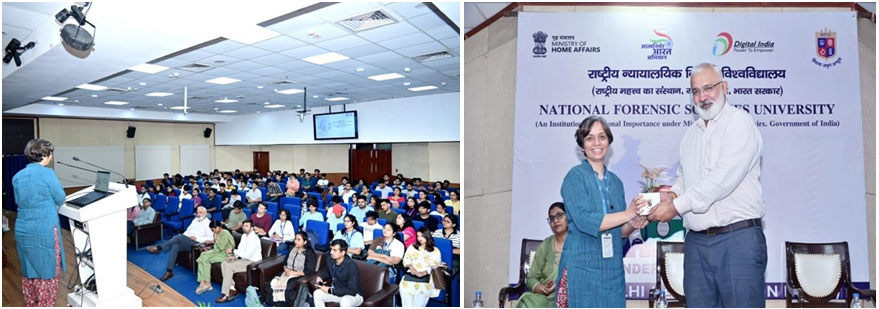
C-DAC Delhi conducted a technology demonstration and hands-on workshop on “Artificial Intelligence for Next-Generation Cyber Security and Human Threat Intelligence” at the National Forensic Sciences University (NFSU), Delhi Campus, an Institution of National Importance under the Ministry of Home Affairs, Government of India. The session was delivered by Dr. Priyanka Jain, Scientist F & Head, Neuro-Cognitive AI & XR Group, C-DAC Delhi, on August 18th, 2026.
The workshop introduced faculty and students to the emerging concept of Human Threat Intelligence (HTI)—an interdisciplinary approach that explores how factors such as stress, fatigue, cognitive overload, attention, decision-making, social engineering and behavioural vulnerabilities can influence cyber risk. It highlighted the potential of AI to move from analysing only digital traces to understanding the human cognitive and behavioural context behind those traces.
Dr. Jain presented the potential of multimodal human-sensing technologies, including EEG brain signals, audio, video and thermal signals, and demonstrated how signal processing, machine learning, deep learning and multimodal AI can be integrated to study human behaviour and cognitive states. A live EEG-based demonstration provided participants with a first-hand view of real-time brain-signal acquisition and its potential relevance to human-centric cybersecurity. The technology demonstration by Ms. Arpita Salunke and Shri Akash Vishwakarma further showcased the emerging possibilities of AI-enabled Human Threat Intelligence, bringing together neuro-technological sensing, behavioural analytics and cybersecurity.
The interaction with Dr. Purvi Pokhariyal, Campus Director, NFSU, emphasised the research opportunities emerging at the intersection of Forensic Science, AI, Neuroscience, Brain–Computer Interfaces, Behavioural Analytics and Cybersecurity, encouraging interdisciplinary exploration by NFSU faculty and students. The event was graced by Dr. Archana Patel, Associate Dean; Col. Nidhish Bhatnagar, Professor of Practice; Dr. Pankaj Sharma, Assistant Professor; and other senior NFSU officers. The engagement reflects C-DAC Delhi’s efforts to advance specialised, interdisciplinary and future-facing AI research, exploring a distinctive cybersecurity paradigm in which the human mind is not merely viewed as the weakest link, but as a potential source of intelligent signals for understanding, predicting and mitigating human-centric cyber threats.
Neuroscience × Behavioural Intelligence × Multimodal AI × Digital Forensics × Cybersecurity — a new frontier in Human Threat Intelligence.