New Delhi
February 9, 2026
The Information Security Education and Awareness (ISEA) Programme, an initiative of the Ministry of Electronics and Information Technology (MeitY), Government of India, successfully concluded the Cyber Hygiene Model United Nations (MUN) 2025 – National Finale, a national-level school initiative aimed at promoting cyber hygiene, responsible digital citizenship, and cybersecurity policy awareness among students.
Cyber Hygiene MUN 2025 was jointly organised by Indian Computer Emergency Re-sponse Team (CERT-In) and C-DAC under the ISEA initiative of MeitY. The programme adopted the Model United Nations format to transform cybersecurity awareness into an interactive, student-led policy discourse. During the 2025 edition, Cyber Hygiene MUN was implemented across 7 states, covering 7 host cities and engaging:
- 124 schools and institutions
- 248 student delegates
- 114 teachers and mentors
- 7 State-Level MUN conferences, each serving as a qualifying round
- 14 top student delegates shortlisted for the national finale (2 per state)
State-level events were conducted in Tamil Nadu, Karnataka, Telangana, Bihar, Delhi/NCR, Uttar Pradesh, and Maharashtra, ensuring wide regional representation and inclusivity.
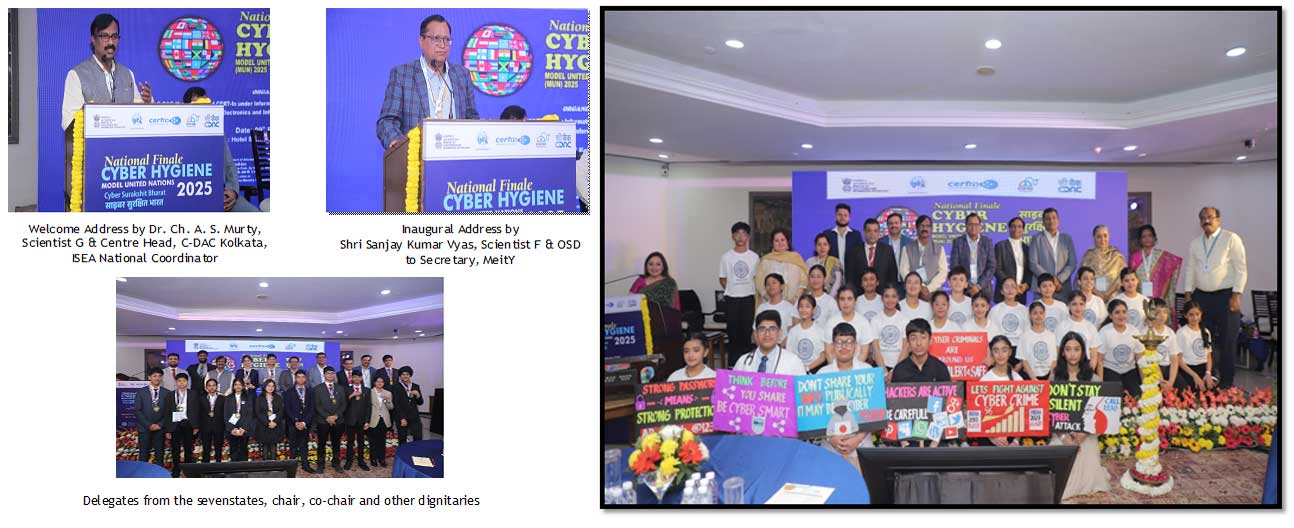
At the national finale, 13 delegates participated in the final deliberations, as one shortlisted delegate was unable to attend.Each state-level Cyber Hygiene MUN followed a uniform, ISEA-approved framework, which included:
- Pre-event orientation on cyber hygiene and MUN procedures
- Committee simulations under UN General Assembly (UNGA/DISEC), UN Human Rights Council (UNHRC), and International Press
- Moderated and unmoderated caucuses
- Drafting and negotiation of cyber policy–focused resolutions
- Evaluation by an expert jury using a standardized 100-mark scoring rubric
Delegates were assessed on research depth, policy understanding, articulation, collaboration, resolution drafting, and professionalism, ensuring transparency and comparability across states.
Across all state chapters and the national finale, deliberations focused on:
- Cyber hygiene practices for students and citizens
- Online safety, cyberbullying, phishing, and misinformation
- Cybercrime awareness and reporting mechanisms
- Digital rights, privacy, and inclusion
- Ethical use of emerging technologies and international cooperation in cyberspace
The discussions resulted in policy-oriented draft resolutions addressing citizen-centric cybersecurity challenges, many of which emphasized early education, awareness campaigns, and youth participation in cyber governance.
The national finale in New Delhi brought together the shortlisted delegates for consolidated deliberations and national-level policy harmonization. The inaugural session was addressed by Shri Sanjay Kumar Vyas, Scientist F and Officer on Special Duty to the Secretary, MeitY, who emphasized:
- The growing digital footprint of children and youth
- The importance of “think before you click” practices
- Strong password hygiene and responsible AI usage
- The need to build cyber resilience rather than reactive security
Senior representatives from CERT-In and C-DAC also addressed the delegates, underscoring the importance of early sensitization, cybercrime reporting awareness, and youth participation in strengthening India’s digital ecosystem.
The programme concluded with a valedictory and award ceremony recognizing outstanding delegates and reaffirming the role of students as future cyber leaders and ambassadors of safe digital practices.
Key outcomes of Cyber Hygiene MUN 2025 include:
- Enhanced cyber hygiene and online safety awareness among 250+ students
- Development of leadership, research, debate, and diplomacy skills
- Creation of a growing network of student cyber hygiene ambassadors
- Strengthened school-level engagement on cybersecurity and digital citizenship
- Demonstrated scalability of a standardized national cyber awareness model
Structured feedback analysis further reinforced the academic credibility of the two-tier model while identifying areas for enhanced operational standardization in future editions.
Cyber Hygiene MUN 2025 aligns with MeitY’s broader vision of building a Cyber Aware Digital Nagarik by embedding cybersecurity awareness at the school level through experiential, participatory learning. The initiative establishes a sustainable and replicable framework that can be expanded to additional States and Union Territories.
National Finale report capturing consolidated resolutions, evaluation outcomes, and expansion strategies will guide future programme cycles.
About ISEA
The Information Security Education and Awareness (ISEA) Project, implemented by MeitY, aims to strengthen cybersecurity awareness and develop skilled human resources through structured training, education, and nationwide outreach initiatives. For more information, visit: www.isea.gov.in | www.staysafeonline.in