Curitiba, Brazil
May 20, 2026
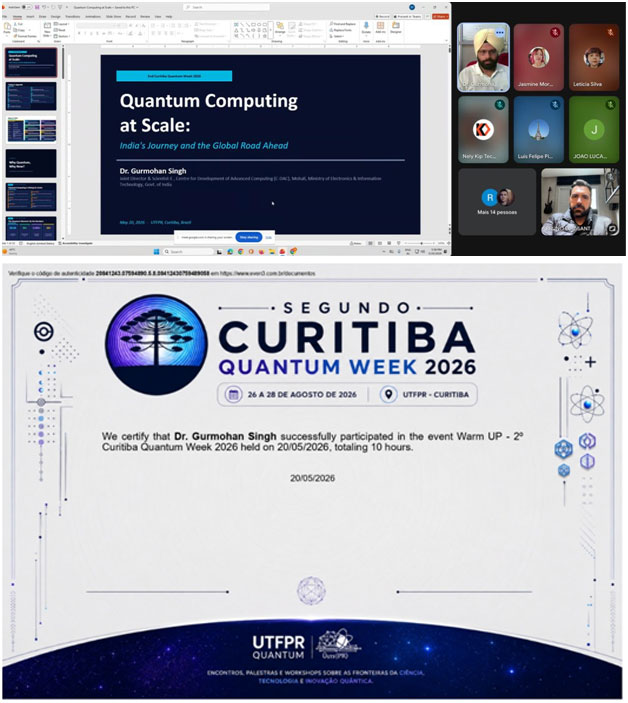
In a significant milestone for bilateral scientific collaboration, Dr. Gurmohan Singh, Scientist Eat C-DAC Mohali, delivered a keynote address titled “Quantum Computing at Scale: India's Journey and the Global Road Ahead” at the 2nd Curitiba Quantum Week 2026, hosted by the Federal University of Technology – Paraná (UTFPR), Curitiba, Brazil.
The online event, held on May20th, 2026 as part of the 2nd Curitiba Quantum Week, brought together Brazil's leading quantum research community, including researchers, academicians, government officials, and industry experts, to explore advancements in quantum computing technologies. The session was also attended by officials from the Indian Mission in Brazil, representing the Ministry of External Affairs (MEA), Government of India.
Presenting India's quantum computing initiatives during the 2nd Curitiba Quantum Week 2026
The address covered the entire spectrum of quantum computing, beginning with the fundamental physics that enable quantum systems to outperform classical ones, and extending to India's strategic investments and C-DAC's advanced applied research. It opened by emphasizing the urgent need driving the quantum revolution and the inherent limitations of classical computing in areas such as drug discovery, climate modelling, cryptography, and materials science. The session underscored that decisions made today will shape national competitiveness for decades to come. It also provided a comprehensive overview of the global quantum landscape, highlighting key milestones from Google's Sycamore quantum supremacy experiment in 2019 to IBM's 1,121-qubit Condor processor (2023) and Google's Willow chip (2024).
Dr. Singh presented India's ambitious National Quantum Mission (NQM), a ₹6,003 crore (~$730M) strategic investment spanning 2023–2031, targeting 50–1,000 qubit quantum computers, quantum communication infrastructure across major cities, post-quantum cryptography standards, and four thematic hubs covering computing, communication, sensing, and materials.
The talk explained how NISQ-era algorithms such as Variational Quantum Eigensolver (VQE) and the Quantum Approximate Optimization Algorithm (QAOA) are already delivering value in molecular simulation, portfolio optimization, logistics routing, and supply chain scheduling, with results from real hardware deployments.
The talk also covered in detail C-DAC's active research projects in areas of Quantum Simulations, Quantum Communication, Quantum Machine Learning Use Cases and Applications, and implementation of NIST-selected PQC algorithms. The participants were also informed about C-DAC's Qniverse platform and coming up 108-Qubit Quantum Reference Facility. The session generated significant interest among attendees, leading to a lively and insightful Q&A that extended well beyond the scheduled time. Participants expressed strong interest in establishing formal research collaborations with C-DAC in several high-impact application domains, including quantum solutions for NP-hard optimization problems, mineral exploration and geophysical analytics, drug discovery and tropical disease diagnostics, and post-quantum cryptography and cybersecurity.
Senior faculty of the Federal University of Technology, Paraná (UTFPR) and organizers of Curitiba Quantum Week acknowledged keynote talk as one of the most comprehensive and practically grounded presentations. The UTFPR Vice-Rector for Research commended the session for bridging the gap between quantum theory and real-world industrial applications and invited C-DAC to be a continuing partner in the Curitiba Quantum Week.
Shri Manoj Sheokand from the Indian Mission in Brazillauded the presentation as a powerful demonstration of India's growing technological stature on the global stage. He particularly appreciated that the address effectively highlighted the National Quantum Mission's strategic ambitions and strengthened the case for deepening India–Brazil scientific and technological cooperation under bilateral frameworks including DST and the ITEC programme.
The keynote session culminated in an extensive and enthusiastic discussion on the concrete steps toward establishing a formal India–Brazil quantum research partnership. Dr. Singh outlined priority areas where collaboration could begin immediately, noting that both nations share complementary strengths India's advanced quantum software stack and applied research depth, and Brazil's world-class university ecosystem, biodiversity datasets, and mineral resource challenges.